How to Choose the Right Fish Finder Size for a Kayak
Bigger is not always better. That is the most important thing to understand before you buy a fish finder for your kayak.
Electronics on fishing kayaks have changed dramatically. What used to be a simple 5-inch sonar unit is now often a full system with side imaging, live sonar, multiple screens, lithium batteries, and mounting hardware that rivals some bass boats. The screens keep getting larger, the technology keeps advancing, and the social media setups keep getting more elaborate.
But kayaks are not bass boats.
Space is limited. Deck layout matters. Battery capacity is finite. And a graph that looks incredible on a 21 foot bass boat can feel completely impractical on a 14 foot fishing kayak.
Choosing the right fish finder size for a kayak comes down to several real factors:
- The type of water you fish
- Whether you sit or stand most of the day
- How heavily you rely on forward-facing sonar
- How portable you need your setup to remain
- How well your mounting and track system can support the weight
The goal is not to run the biggest screen possible. The goal is to build a setup that helps you fish more efficiently without adding unnecessary weight, clutter, or rigging problems.
Why Fish Finder Size Matters More on a Kayak
On a bass boat, screen size is mostly about preference. There is usually plenty of mounting space, battery capacity, and deck room to accommodate whatever the angler wants to run.
Kayaks operate completely differently.
Every inch of deck space competes with rods, landing nets, tackle storage, pedal systems, and fish handling. Viewing distance from the graph changes the moment you stand up to fish. Sunlight angles hit differently on the water. And a mounting system that feels solid in a parking lot can start flexing and rattling the moment you hit rough water.
There is also the weight problem most anglers underestimate.
Larger screens require larger batteries. Larger batteries add weight. Added weight affects kayak handling, launch and load logistics, and overall portability. Once you start chasing bigger electronics without a clear plan, the entire setup can snowball into something heavier, more complex, and harder to use than you intended.
Bigger graphs also create specific demands on your mounting setup. As screens get larger, the leverage acting on your track system increases. A weak or undersized track will flex, vibrate, and shift under the load of a large graph, especially on big water. That instability does not just feel annoying. It makes your screen harder to read and easier to damage.
This is why the mounting system and the graph are really one decision, not two.
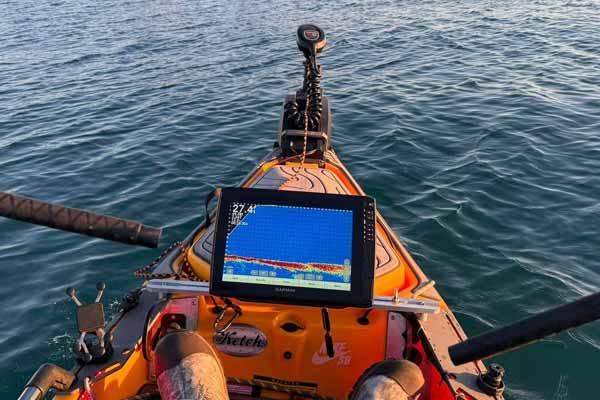
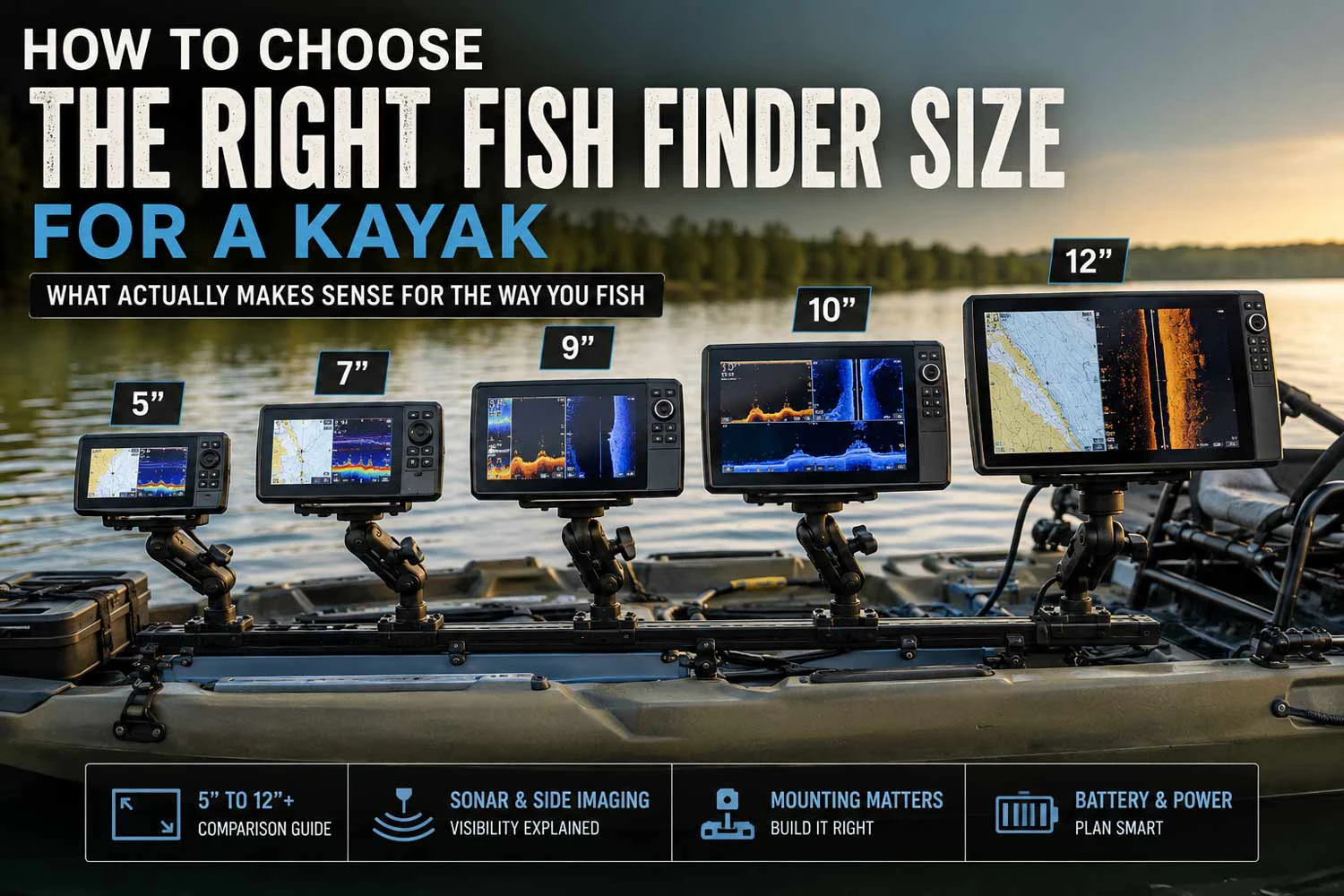
The Real Differences Between 5″, 7″, 9″, 10″, 12″, and 16″ Screens
The jump between screen sizes is larger on the water than it looks in a store or an online photo. As size increases, the way you use sonar, mapping, split-screen layouts, and live sonar changes fundamentally.
Here is what each size actually delivers in a kayak context.
5-Inch Units
Best for minimalist setups, rivers and small creeks, and anglers who prioritize portability above all else.
Five-inch graphs still earn their place in specific situations:
- Basic sonar and mapping
- Lightweight kayaks with limited deck space
- Short trips on shallow water
- Budget-conscious builds
The limitations show up fast once your fishing gets more technical. Split-screen layouts get cramped. Side imaging becomes hard to read. And standing up to fish while trying to interpret a 5-inch screen in bright sunlight is a real challenge.
For most modern kayak anglers, the 5-inch category is a specialty choice, not a go-to.
7-Inch Units
The best overall balance for a wide range of kayak anglers.
This is where mapping becomes genuinely useful, split-screen layouts start working, and side imaging becomes worth running. The screen is large enough to read comfortably without overwhelming a compact kayak layout.
Seven-inch units work well for:
- General bass fishing
- Casual tournament anglers
- Mixed lake and river use
- Anglers who want strong functionality without heavy rigging
For many kayak anglers, a quality 7-inch unit is still the smartest all-around choice. It fits almost any kayak layout, places manageable demands on battery systems, and covers the majority of what most anglers actually need on the water.
9-Inch Units
Where serious electronics setups begin.
The difference between a 7-inch and a 9-inch screen is immediately noticeable on the water, especially when running:
- Side imaging
- Split-screen sonar views
- Detailed mapping
- Forward-facing sonar
- Waypoint management
For anglers who stand frequently while fishing, 9-inch graphs are often the first size where visibility at a distance becomes genuinely comfortable.
This is also the point where mounting systems stop being an afterthought. A 9-inch graph mounted on a weak arm or an undersized track will flex, vibrate, and shift in rough water. If you are running a 9-inch unit or larger, a heavy-duty track system is not optional. It is part of the setup.
Nine-inch units have become extremely popular among tournament kayak anglers because they balance advanced screen capability with manageable size, weight, and power demands.
This is also realistically the first screen size where forward-facing sonar becomes truly practical on a kayak. While smaller units can technically run live sonar, interpreting fish movement, lure tracking, and directional casting information becomes much easier once screen size reaches the 9-inch range.
For anglers wanting to get into forward-facing sonar without building a massive electronics setup, a 9-inch graph is often the most realistic starting point.
10-Inch Units
The emerging sweet spot for forward-facing sonar on a kayak.
Ten-inch graphs sit directly between the compact practicality of a 9-inch unit and the full-size commitment of a 12-inch setup. For many serious anglers, this is where the balance lands.
The advantages over a 9-inch unit are real:
- More room for split-screen layouts
- Easier interpretation of live sonar
- Better visibility while standing
- More comfortable reading during long tournament days
At the same time, most 10-inch units remain more manageable than a 12-inch setup when it comes to battery draw, overall weight, and deck footprint.
For tournament anglers running forward-facing sonar who want maximum visibility without fully committing to an oversized system, 10-inch units are increasingly the answer.
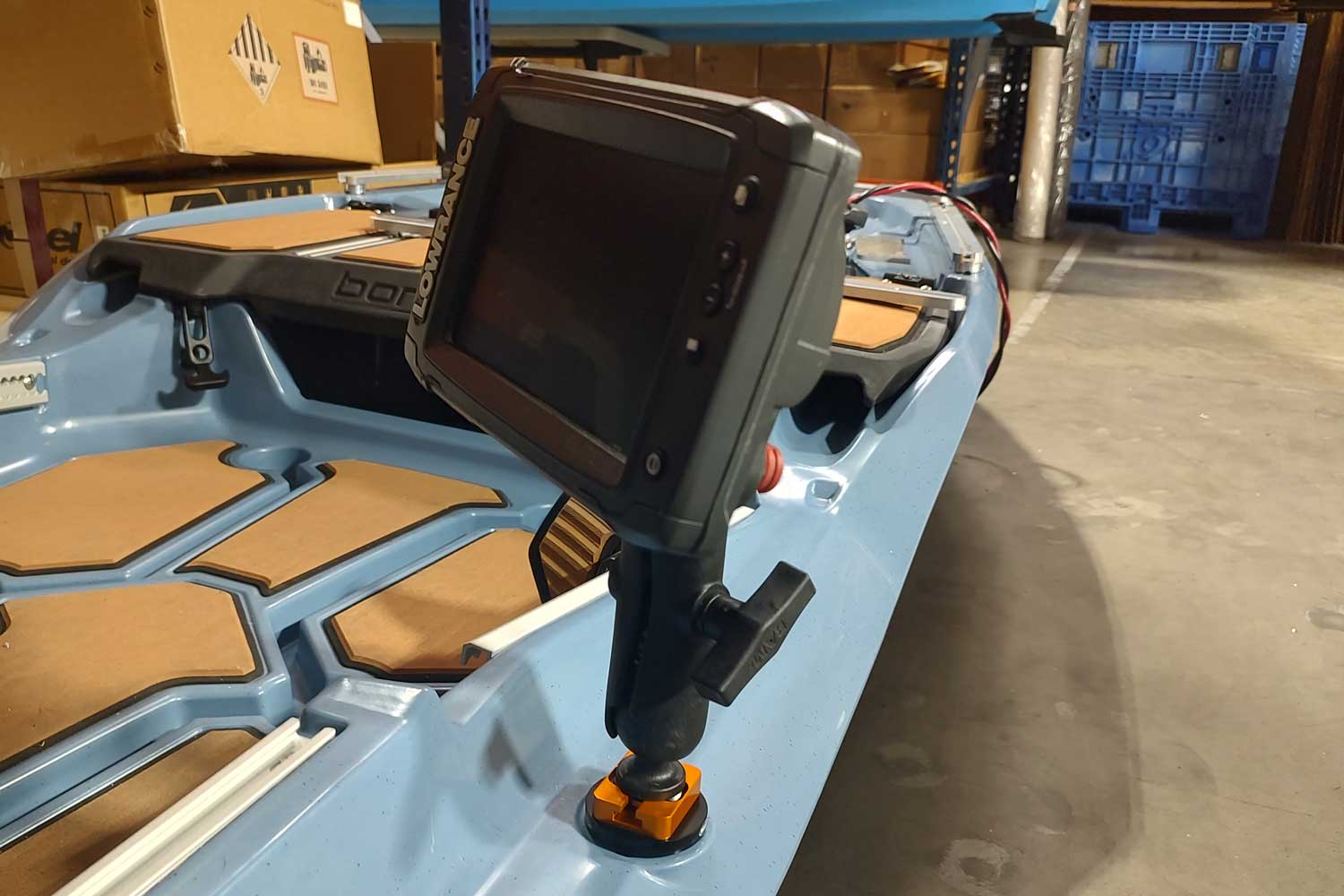
Once you move into larger and heavier 10″, 12″, and especially 16″ fish finder setups, mounting stability becomes a major factor. Heavy graphs can flex factory mounting points, vibrate in rough water, and become difficult to position correctly without a reinforced system. Purpose-built crossbar systems like the Ketch Krossbar for the Hobie PA 14 Kayak are designed specifically to handle the added weight and leverage of today’s larger electronics.
12-Inch Units
Built for anglers who prioritize maximum visibility and information management.
Twelve-inch graphs have become increasingly common in advanced kayak fishing setups, driven largely by the growth of live sonar. At this size, split-screen views open up significantly, and interpreting fish movement while standing becomes noticeably easier.
The tradeoffs are real and impossible to ignore:
- Stronger mounting systems required
- Substantially more battery draw
- Significant deck space commitment
- More transport complexity
- Added weight throughout the system
At this level, the fish finder stops being an accessory and starts being a major architectural decision for the entire kayak. Your mounting system, track setup, battery capacity, and deck organization all have to be built around supporting it.
For offshore anglers, tournament-focused anglers, and heavy live sonar users, a 12-inch graph can be a legitimate performance advantage. For others, it often creates more complexity than it delivers benefit.
In general, larger screens are better for forward-facing sonar applications as long as:
- The kayak layout can support them
- The mounting system remains rigid
- Battery capacity is sufficient
- Deck space stays functional
- The added weight and complexity remain manageable
There is a point where oversized electronics can begin creating more problems than advantages on smaller or more compact kayak layouts.
16-Inch Units
Specialized setups only.
Sixteen-inch graphs exist almost entirely in the high-end, highly specific category. These builds are typically designed around:
- Dedicated forward-facing sonar use at a distance
- Offshore structure fishing
- Maximum visibility in highly competitive tournament environments
The visibility is unmatched. But the demands are serious.
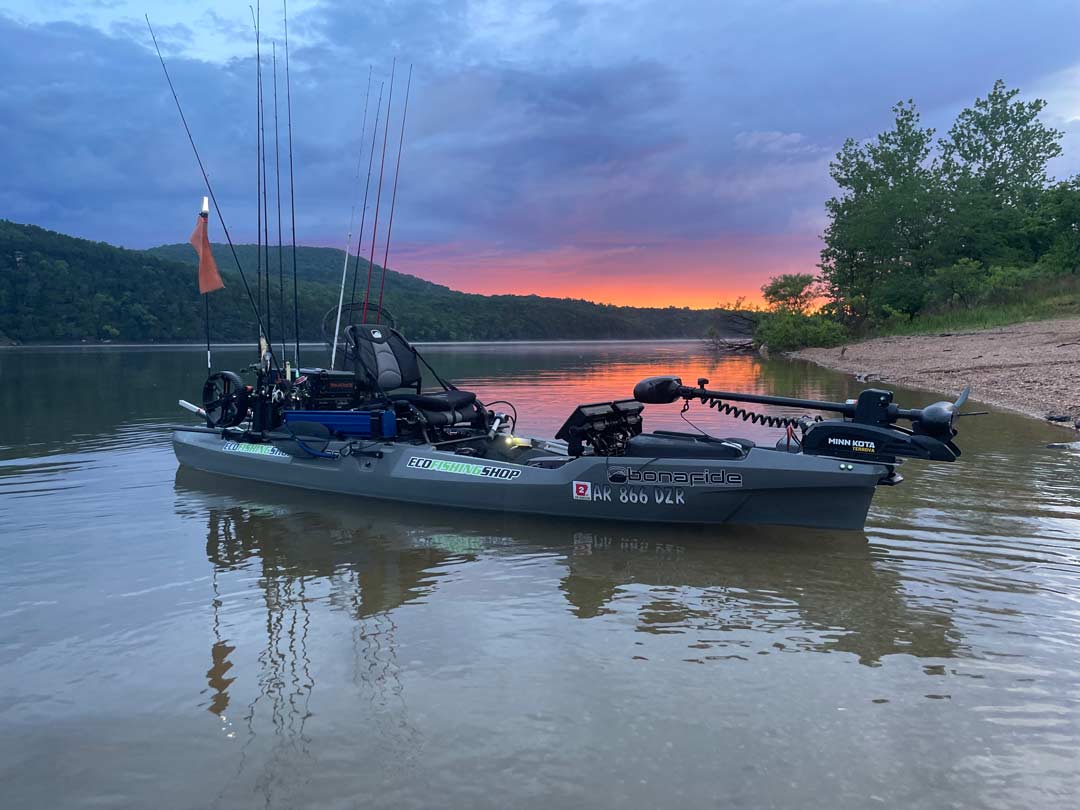
A 16-inch graph requires large battery systems, reinforced mounting, reorganized deck layouts, and a kayak platform large enough to support all of it without compromising fishability. In practice, 16-inch setups are only truly practical on the newest generation of oversized kayaks, platforms like the Bonafide XTR130 that are specifically designed around advanced electronics, motors, and heavy rigging.
For the majority of fishing kayaks on the market, a 16-inch graph is simply too large to integrate cleanly. A well-rigged 9-inch, 10-inch, or 12-inch setup will deliver a far better overall balance for most anglers.
Running Dual Graphs on a Kayak
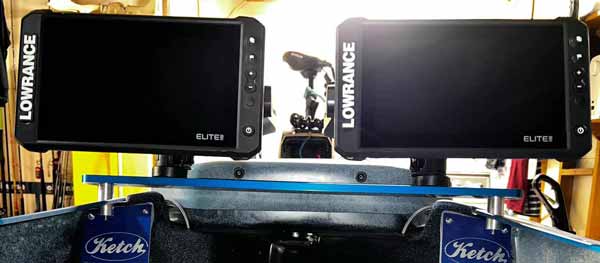
Some serious tournament anglers and live sonar users have moved beyond choosing a single screen size entirely. They run two graphs.
The most common dual graph configuration pairs a dedicated forward-facing sonar display with a traditional sonar and mapping unit. This keeps live sonar interpretation completely separate from navigation, structure reading, and waypoint management, so neither screen gets cluttered by split-screen layouts.
It sounds like the obvious solution. In practice, it introduces real tradeoffs.
Dual graph setups work when:
- The kayak platform is large enough to support two mounting positions without crowding the cockpit
- The track system can handle the combined weight and leverage of multiple units
- Battery capacity is planned around the increased draw of two screens running simultaneously
- The angler is experienced enough to manage two screens without creating a distraction problem on the water
The weight and battery demands alone rule out dual graphs for most kayak builds. Running two graphs, two transducers, and the additional cabling that comes with it adds meaningful weight to the front of the boat, changes trim, and pushes battery requirements significantly higher.
The mounting demands are equally serious.
Two graphs require two mounting positions that are rigid, adjustable, and positioned for visibility whether you are seated or standing. Any flex or instability in the track system gets multiplied when two heavy units are applying leverage simultaneously. The Ketch Krossbar is purpose-built for exactly this situation, giving you two independent mounting points from a single track position so dual graphs stay organized, adjustable, and stable without requiring a completely redesigned deck layout. That rigidity under load is exactly what the X-Aktrak HD Heavy Duty Track System is built to support.
Dual graph builds are not beginner setups. They are not setups for compact kayaks. And they are not necessary for the majority of tournament anglers who can accomplish the same goal with a well-chosen single 9-inch, 10-inch, or 12-inch unit running a split-screen layout.
But for anglers running advanced forward-facing sonar on large open-water fisheries, a properly planned dual graph setup can eliminate the interpretation compromises that come with split-screen viewing and genuinely improve on-water efficiency.
The key word is planned. A dual graph build that is not fully thought through from track system to battery capacity to deck organization creates more problems than it solves.
How Forward-Facing Sonar Changed the Screen Size Conversation
Before live sonar became widespread, many kayak anglers ran 5-inch or 7-inch units without any issue. Traditional sonar, down imaging, and mapping did not require large screens to use effectively.
Forward-facing sonar introduced something completely different.
Instead of glancing at contour lines or structure between casts, anglers are now actively watching live movement on the screen in real time:
- Fish positioning relative to the lure
- Bait movement
- Lure tracking through the water column
- Fish reactions and directional adjustment
That kind of real-time interpretation becomes dramatically easier as screen size increases. This is why many anglers who were previously satisfied with 7-inch units moved into 9-inch, 10-inch, or 12-inch setups after adding live sonar.
At the same time, forward-facing sonar setups introduce real rigging demands:
- Larger batteries
- Additional transducers and cables
- More advanced mounting systems
- More deck space
- More transport planning
Bigger screens do not automatically make anglers more effective. Anglers who understand how to interpret sonar information clearly and apply it quickly will always out fish anglers who simply bought more screen.
Many highly effective kayak anglers still run compact setups built around traditional sonar and mapping. Forward-facing sonar is a powerful tool, but the best screen size still depends on how heavily electronics actually influence your fishing.
Battery and Power Planning
As fish finder size increases, battery demands increase with it. This is one of the most overlooked parts of building a kayak electronics setup.
Larger screens draw more power. But the real battery load often comes from everything added alongside the screen:
- Forward-facing sonar modules
- Multiple graphs
- Live imaging transducers
- Running lights
- Trolling or pedal-assist motors
- Phone charging
- Action cameras
Once all of those accessories are running simultaneously during a full tournament day, battery planning becomes a major part of the overall system.
Lithium batteries have become the standard in serious kayak fishing setups for good reason:
- Significantly lower weight than lead-acid
- Longer runtime
- More stable voltage output
- Faster recharging
- Better long-term efficiency
Weight matters far more on a kayak than most anglers realize until they are carrying the boat across a long parking lot or launching off a steep bank.
The goal is not simply to power the largest electronics possible. The goal is building a power system that stays reliable, efficient, and manageable for the way you actually fish, whether that is a three-hour river trip or a ten-hour offshore tournament day.
Mounting Is Not an Afterthought
This is where many kayak electronics setups fail, and it is where the fish finder size decision becomes a rigging decision.
A small graph mounted close to the kayak creates very little stress on the mounting system. But once you move into 9-inch, 10-inch, and 12-inch units, the forces acting on the mount increase substantially, especially in rough water.
The physics are simple. A heavier screen mounted on a longer arm creates more leverage. Every wave, wake, and rough-water run applies that leverage directly to the track and mount. A weak system will flex, vibrate, and shift, making the screen harder to read, harder to keep positioned, and more vulnerable to damage over time.
Common problems with undersized mounting systems:
- Screen shake at speed
- Mount flex in rough water
- Track movement under load
- Difficulty keeping screens positioned correctly
- Hardware loosening over multiple trips
These problems get worse as graph size increases. And they are not just annoying. They are fatiguing over a full day on the water and actively interfere with using the electronics effectively.
A rigid, well-matched track and mounting system does more than hold the screen in place. It keeps your setup stable, your screen readable at a distance, and your adjustment consistent throughout the day.
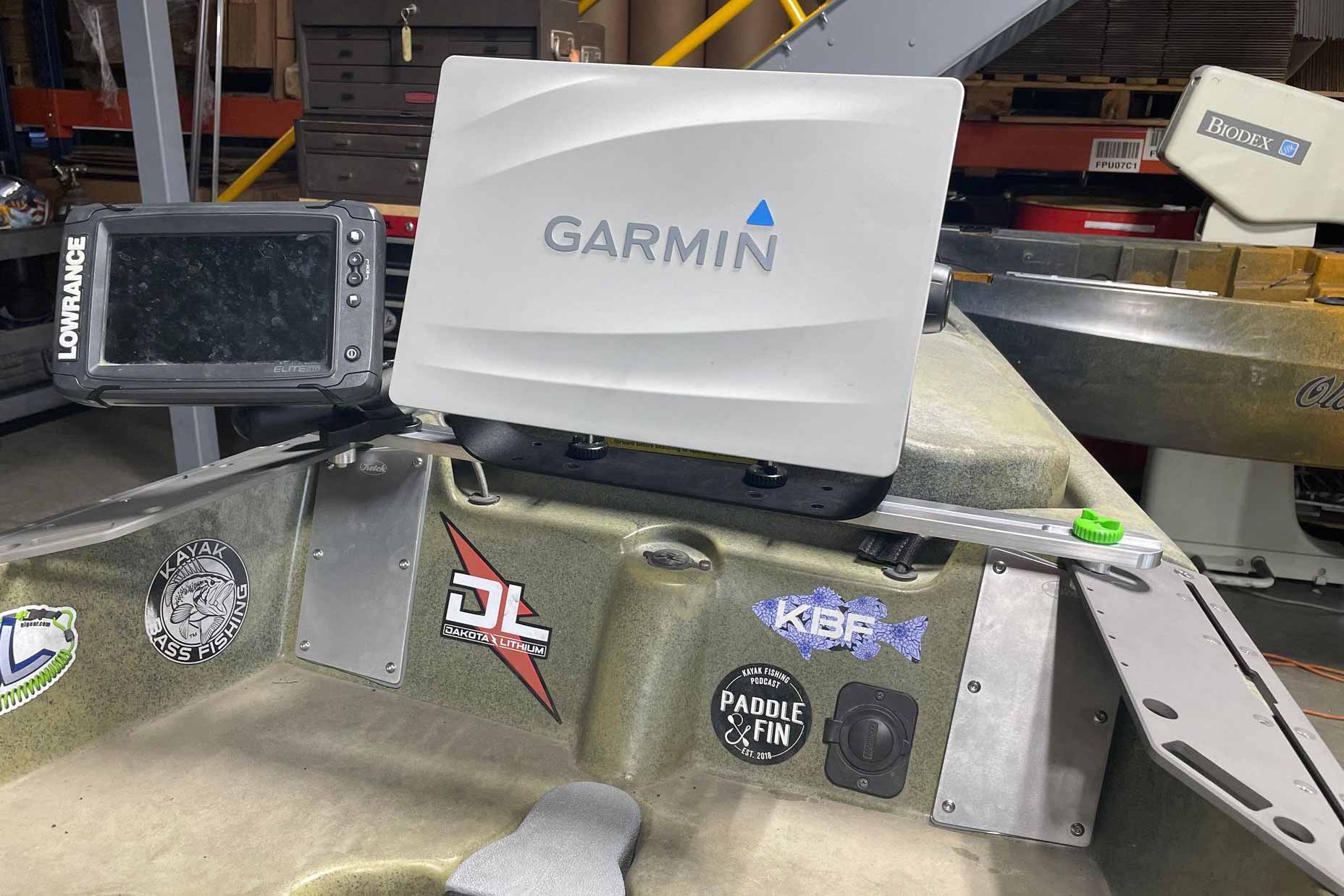
If you are building a setup around a 9-inch graph or larger especially when adding dual graphs, the track system supporting it needs to be rated for the load. A heavy-duty track is not a luxury in that situation. It is a foundational part of the build. The X-Aktrak HD Heavy Duty Track System is built specifically for this kind of load-bearing kayak rigging, handling the leverage demands of larger electronics setups without flex or movement under pressure.
For lighter builds running 7-inch units or smaller, the X-Aktrak LT Light Track offers a lower-profile solution that still delivers solid, reliable performance without overbuilding the system.
The mounting setup should be matched to the graph size, not treated as an afterthought after the screen is already purchased.
The Most Common Mistake
The biggest mistake kayak anglers make when choosing a fish finder is buying based on what looks impressive online instead of what actually fits the way they fish.
Tournament setups on social media often feature massive graphs, multiple screens, live sonar, large batteries, and elaborate mounting systems. It is easy to assume that bigger is better because those are the builds getting the most attention.
But many of those setups are built for very specific situations, offshore structure fishing, electronics-heavy tournament formats, and large open-water reservoirs that do not apply to the average angler’s day on the water.
Chasing oversized electronics often creates problems:
- Unnecessary weight throughout the system
- Reduced portability and transport complexity
- Crowded cockpit with less room to fish
- Increased battery demands
- More rigging and maintenance complexity
All of that without actually improving the fishing experience.
The right setup is the one that supports your fishing style without creating unnecessary compromises everywhere else on the kayak.
What Size Fish Finder Makes Sense for You?
There is no universal answer. The best choice depends on your specific situation.
5-Inch: Best for minimalist setups, rivers and creeks, lightweight builds, and anglers who prioritize portability over advanced sonar features.
7-Inch: Best overall balance for the majority of kayak anglers. Strong functionality, manageable size, fits almost any kayak layout without overcomplicating the build.
9-Inch: Best for serious tournament anglers, side imaging users, anglers who stand frequently, and anyone entering forward-facing sonar for the first time. This is the first size where live sonar becomes truly practical to interpret on a kayak.
10-Inch: Best for advanced electronics setups and forward-facing sonar users who want larger visibility without fully committing to the size, weight, and complexity of a 12-inch system. Increasingly the sweet spot for tournament anglers running live sonar.
12-Inch: Best for offshore fishing, electronics-focused tournament builds, and heavy live sonar use. Delivers maximum split-screen space and visibility while standing, but requires a kayak layout, mounting system, and battery capacity that can support it.
16-Inch: Highly specialized use cases only, overkill for almost all kayaks but can be used on highly advanced systems on oversized kayak platforms like the Bonafide XTR130. Most kayak anglers do not need one, and most kayak layouts cannot support one.
Build the Setup Around How You Fish
Modern kayak electronics have made it possible to build genuinely capable fishing platforms at almost any budget and experience level.
But the best setup is not the biggest one. It is the one that fits the way you fish, stays efficient throughout a full day on the water, and does not create unnecessary tradeoffs everywhere else on the kayak.
Match the screen size to your fishing style. Match the mounting system to the screen size. And build the battery capacity to support the system you actually need, not the one that looked the most impressive online.
If you are building or upgrading your kayak setup, explore the full lineup of Ketch kayak rigging, mounting, and electronics solutions designed to help serious anglers build cleaner, stronger, and more efficient fishing platforms.